

This post-event recap is presented by Komar Distribution
This past Tuesday, New Edition co-hosted our sixth Ugly Talk inside a packed house at Shopify New York.
I sat down with Seth Goldstein (Masa Chips), Millie Blumka (Stakt) and Quincy Moore (New York or Nowhere) to talk about how they're actually approaching BFCM this year.
These are three very different businesses at three very different stages.
🌽 a challenger CPG brand going all-in on retail
🧘🏻♀️ a wellness brand with a cult community in seven cities
🗽 an eight-figure streetwear label that's never taken outside money or run a paid ad.

From Left: Anson (Ugly Talk), Seth (Masa Chips), Quincy (New York or Nowhere), me & Millie (Stakt)
If you weren't in the room, below are my five favorite takeaways that'll help you make smarter calls heading into BFCM.
BUT FIRST, HERE ARE A FEW UPCOMING NEW EDITION EVENTS TO CHECK OUT …
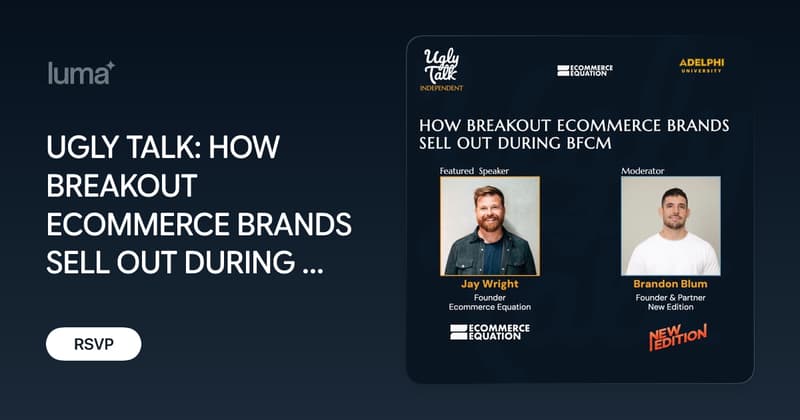

📅 Subscribe to New Edition Events Calendar here.
Want to partner on an event? Respond directly to this email.
OH, AND HERE ARE OUR WINNERS FROM THIS WEEK’S $100 GIFT CARD GIVEAWAY…
$100 DIGITAL GIFT CARD // Masa Chips: Len Bilello
$100 DIGITAL GIFT CARD // New York or Nowhere: Courtney Coviello
$100 DIGITAL GIFT CARD // Stakt: Zoe Schwartz
1. The Best Black Friday Discount Might Be the One Nobody Sees

All three panelists discount for BFCM. None of them are doing a public, site-wide blowout.
"The optics of going on sale is not great."
Seth skips public sales entirely. Masa Chips sends a "why we're not doing a sale" email instead, and quietly offers postcards and emails targeted only at past purchasers.
Millie's Stakt runs a structured 20% off sitewide / 25% off bundles, plus "5 Days of Stakt" in December — discount tied to margin, and one of the only times all year Stakt discounts at all.
Quincy goes furthest: a "mystery sale" (undisclosed discount, historically huge volume) and a word-of-mouth "secret sale" — roughly 70% off, gone in minutes. Even Brandon struck out this year.
The lesson: a public, blanket discount can cheapen a brand you've spent years building. Structured, targeted, or even secret discounting protects your margin and your brand equity — and it makes the people who do get the deal feel like they're in on something.
Action item: before you build your BFCM sale, decide who actually needs to see it. Past purchasers, VIPs, and your community aren't the same audience as a homepage banner.
2. Excess Inventory Is a Marketing Budget, Not a Markdown

Before Masa Chips had its own factory, Seth was buying tortillas from outside suppliers and regularly ended up with surplus he hadn't planned for — extra runs of "blue masa," for example.
"It's not a bug, it's a feature."
Instead of discounting it away, he turned it into gifting and activation inventory: product for events, seeding, and surprise-and-delight moments that a straight markdown never buys you.
The lesson: the reflex when you're overstocked is to slash price. The better question is whether that inventory can do a job a discount can't — get product into new hands, fuel content, or make an event memorable.
👇 HERE’S MY FREE OFFER TO YOU 👇

3. What to Keep, What to Cut This Year: Three Different Answers

Asked what they're continuing from last year and what they're cutting, the panel split into three completely different strategic bets.
Millie is bringing on a contractor to run email this year — it had all been landing on her, and Stakt is a lean team of six.
Seth is keeping his "Happy Thanksgiving, hope you enjoy" no-offer nurture email — a deliberate signal that Masa Chips isn't just there to push chips on people.
Quincy's biggest move isn't a tactic at all — it's timing. New York or Nowhere is opening its second retail store to coincide with Black Friday.
The lesson: "what worked last year" isn't one playbook. It might be a hire, an email you don't send, or a real-world decision like a store opening. Look at your own bottleneck before you copy someone else's tactic.
Email Marketing Tip: Segment your list by who opened, clicked, or purchased on last year's BFCM. "People who purchase on a sale often come back for a sale."
4. Build the Brand Before You Chase Retail

A year ago, Masa Chips was roughly 90% D2C. Today it's closer to 50/50. Seth's projecting 90% retail within a year.
"Retailers won't build your brand for you."
His framework: build the brand first, then go to retail — not the other way around.
It's working. Masa Chips currently:
holds roughly 70% market share in tortilla chips at Erewhon
is the #1 tortilla chip at Sprouts and Whole Foods
is gaining ground at Target
Seth's mental model for pricing: think Goya (a great business, thin margins, no brand feeling) versus LVMH, Prada, or Chanel (the customer pays a 95% margin and still feels good about it). "Brand is delivering more value to your customer than your COGS costs to make it."
The lesson: retail doesn't build brand equity — it monetizes it. Walk into a buyer conversation with a brand people already want, not a product you're hoping they'll build demand for.
5. Community Isn't a Launch Tactic — It's a City-by-City Build

Stakt's Blue Bag program — mats stored in lockers so members can grab one, work out, and drop it back off — is now live in seven cities.
"Our husbands wanted to kill us."
It didn't start that way. Millie and her co-founder Taylor began by hand-carrying roughly 40 mats each to events straight from their NYC apartments.
It grew because every trainer and instructor they worked with brought their own community along — a ripple effect, one relationship at a time.
Her advice for anyone worried about production value: "iPhone does the job just fine."
The lesson: community compounds through other people's networks, not just your own. And it doesn't need a content budget to start — it needs a few genuine relationships and a willingness to carry the mats yourself.
RAPID FIRE

A few of our favorite off-the-cuff answers from the night:
Shopify tool they can't live without: Millie and Quincy both said Sidekick, Shopify's AI assistant — "anything I need to get done, I just ask Sidekick to cut my time in half." Seth's team swears by Better Reports.
One book every founder should read:
Customer Centricity by Peter Fader (Seth)
Unreasonable Hospitality by Will Guidara and Be Quick But Don't Hurry by John Wooden (Quincy)
Shoe Dog by Phil Knight (Millie).
One thing to remember:
"Do things worth doing" (Seth).
"Celebrate the small wins — look back at where you were six months or a year ago" (Millie).
And from Quincy, only half-joking: "Knicks in five."
If you missed this one, I hope to see you at a New Edition Event soon!
Which was your favorite takeaway above?
Shoot me an email ([email protected]) and let me know.
See you next time ✌️
